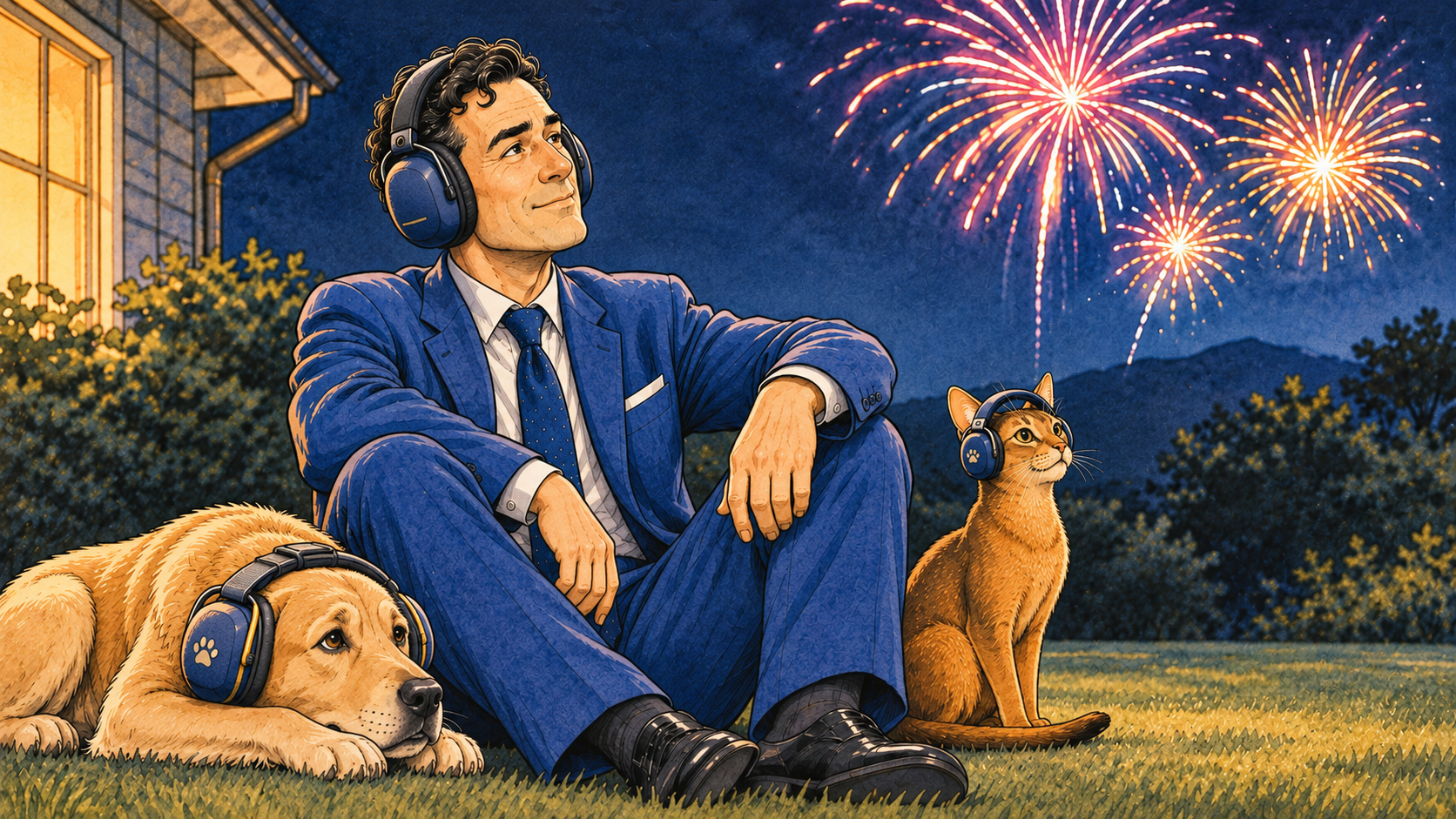
Every year as November comes around, the country has the same argument about whether fireworks should stay on sale to the public. Firefighters, veterinarians, animal welfare groups and pet owners have been the loudest voices, and the weight of public opinion appears to sit with them. Petitions to Parliament have gathered around 95,000 signatures between them (Sands, 2025), and surveys have consistently found that most New Zealanders want private use restricted or stopped altogether. A select committee recommended a ban earlier this year and the Government declined to act on it (McCulloch, 2026), so fireworks will again be on sale to over-18s from 2nd to 5th November.
Every year the Ministry for the Environment publishes an update on how fireworks are regulated, and it tallies up the harm they cause, including fires attended, calls to police and injury claims lodged with ACC (Ministry for the Environment, 2026). Those are the things that produce a callout or a claim, so those are the things that get counted, and hearing damage is counted nowhere at all. Someone who leaves a display with ringing ears does not ring the police or lodge a claim, so that night never appears in anyone's figures.
The fire and animal welfare arguments have been well made by the people who deal with those consequences directly. The hearing side has not, and it should be, because the ear is the organ most directly in the path of what a firework produces. That is the part I want to set out here.
How loud is a firework, really?
Fireworks come in two broad types, being the ones built to look impressive and the ones built mainly to make a bang, such as firecrackers (Reategui-Inga et al., 2024). New Zealand dealt with the second group a long time ago, since skyrockets and firecrackers have been banned here since 1994 and sales are limited to four days each year from 2nd to 5th November, although what you can still buy is plenty loud enough to matter. Either way there are two things coming off a firework that affect the people and animals nearby, namely the noise of the explosion and the smoke that follows it, and that smoke carries fine particles and gases that are not good to breathe (Chatterjee et al., 2013; Yang et al., 2014).
A large aerial shell usually bursts somewhere between 100 and 200 metres up, occasionally as high as 270 metres, throwing out a ball of light and sound that can be 150 metres across (Zrnic et al., 2020). Close to where it is launched, the noise can peak at around 160 decibels, which is more than enough to tear an eardrum, and the people who set displays off are regularly working in noise above 100 decibels (Flamme et al., 2009; Tanaka et al., 2016). For some sense of scale, an ordinary conversation sits at about 60 decibels and a petrol lawnmower at about 90, and because of the way the decibel scale works, every extra 10 decibels sounds roughly twice as loud again to the ear.
What makes a firework different from a noisy workplace is not only the volume but the speed. Workplace noise limits are built around an average of 85 decibels spread across an eight hour day, which assumes a reasonably steady sound you are sitting in for a long time. A firework is the opposite of that, because it goes from silence to full volume in less than a thousandth of a second. The ear does have a defence of its own, a small reflex that tightens the chain of tiny bones in the middle ear when a loud sound arrives and takes some of the force out of it, but that reflex needs a few hundredths of a second to kick in, by which point the bang has already been and gone. In other words, your ear never gets the chance to protect itself.
The effects on your ears
Most people who stand anywhere near a display will notice something afterwards, usually a dullness or muffling as though the ears have been packed with cotton wool, often with a ringing or buzzing alongside it, which is tinnitus. For most people that settles over the next day or so and hearing comes back to normal, and this is what we call a temporary hearing loss. The part worth understanding is that it is a warning rather than an all clear, because the ear only behaves that way when it has taken a genuine hit.
What turns that into a lasting problem is repetition. Damage can begin at around 120 decibels even from a single brief exposure, and a good deal of what goes on sale clears that comfortably at close range, so each loud night leaves a little behind in the form of damage to the fine connections between the inner ear and the hearing nerve. That damage does not show up on a standard hearing test, which is part of why people can be told their hearing is normal and still find themselves lost in a noisy restaurant, and over enough occasions it becomes permanent hearing loss and tinnitus that no longer settles (Passos et al., 2021). Occasionally a single blast at very close range will do the same thing in one go.
Children deserve particular attention when it comes to fireworks. Loud, sudden noises can damage hearing at any age, but younger children may not recognise when sound levels are dangerous or know when to move away. They also rely on adults to provide appropriate hearing protection.
For people already living with tinnitus or sensitivity to sound, fireworks can be particularly challenging. The unpredictable nature of the explosions can make them difficult to anticipate, and sudden loud noises may temporarily aggravate existing symptoms. It's something I hear about in clinic every year.
The effect on animals
The same thing happens to pets and wildlife, with the added difficulty that an animal has no idea what is coming or why. Dogs and cats tremble, hide, chew at things and try to escape, while birds and livestock can panic, lose their bearings and injure themselves on fences and gates. The SPCA puts the figure at around 75 percent of cat and dog owners reporting that their animal is frightened, rising to about 80 percent among horse owners, and the research shows the fear tends to get worse rather than fade with repeated exposure (Riemer, 2019). Most animals hear much higher frequencies than we do, so a firework that is loud to us is louder still to them, and the deep rumble travels well enough that an animal several streets from a display is still very much inside the event.
When public displays happen in New Zealand
Organised public displays can be held at any time of year, as long as the organisers hold a permit from Fire and Emergency New Zealand and meet the safety requirements. In practice, most of them fall around:
Guy Fawkes Night, 5th November
New Year's Eve, 31st December
Matariki, with occasional approved displays in June or July
Local events and festivals, on dates approved by Fire and Emergency New Zealand
There is no fixed legal window for public displays, only the requirement for certified handlers and advance approval.
How to protect yourself and your family
There is a sensible middle position available here, which is that you can enjoy a display without accepting an injury you did not need to have.
Wear hearing protection, since foam earplugs cost a couple of dollars and ear muffs are easy to fit on a child, and either one is far better than nothing.
Keep your distance, because standing at least 500 metres back from where the fireworks are launched puts you well clear of the levels that do damage, and the display looks much the same from there.
Get behind quieter alternatives, since low noise fireworks, laser shows and drone displays all work perfectly well for community events and are being used more and more overseas.
Have your hearing checked if something changes, particularly if you come away from an event with ringing, muffled hearing or a new sensitivity to sound that has not settled down within a day or two.
How to protect your animals
Keep pets inside with somewhere quiet and secure to retreat to, and make sure their collar tags and microchip details are up to date in case they bolt.
Shut windows, curtains and doors, and leave music or a television on to cover the sharpest of the bangs.
Think about desensitisation well ahead of the season, which means playing recordings of fireworks very quietly at home and building up gradually over several weeks, as this can genuinely reduce the fear response.
Encourage your council to approve professional, low noise displays rather than leaving the noise to whoever has picked up a pack at the supermarket.
What we could do differently
Several European cities have already switched to silent fireworks or drone light shows for their public celebrations, and the experience there suggests people turn out for these events just as happily as before. That matters, because the argument tends to get framed as a choice between tradition and safety, when in truth the tradition is the gathering and the spectacle rather than the decibels. A community display that draws the same crowd without the noise costs the audience nothing worth keeping.
Whichever way the rules eventually go, the clinical position does not change, because noise damage of this kind is permanent, it adds up over a lifetime, and it is almost entirely preventable. The ear does not repair itself, and there is no treatment that gives back what a loud enough exposure takes.
A closing note
I am not asking anyone to give up something they enjoy, only that it not be the night someone takes a blast at close range and ends up with tinnitus they keep for good, and that it not become one more entry on a lifetime's tally of loud exposures, which is what adds up to the hearing problems people come and see me about. A pair of earplugs and a bit more distance from the launch site will cover most of that, and the children and animals who cannot make the decision for themselves are worth a thought as well.
If you or someone in your family has noticed a change in hearing after a display, or if you are living with tinnitus that gets worse around this time of year, we are here in Napier and Hastings and happy to take a look.
References
Chatterjee, A., Sarkar, C., Adak, A., Mukherjee, U., Ghosh, S. K., & Raha, S. (2013). Ambient air quality during Diwali festival over Kolkata: A mega-city in India. Aerosol and Air Quality Research, 13, 1133–1144.
Flamme, G. A., Liebe, K., & Wong, A. (2009). Estimates of the auditory risk from outdoor impulse noise I: Firecrackers. Noise and Health, 11(45), 223–230. https://doi.org/10.4103/1463-1741.56216
McCulloch, C. (2026, October 9). 'Enough is enough': New Zealand First wants to ban fireworks. RNZ. https://www.rnz.co.nz/news/politics_election-2026/1801767/enough-is-enough-new-zealand-first-wants-to-ban-fireworks
Ministry for the Environment. (2026). Annual update on the regulation of fireworks in New Zealand 2026 (Briefing 26-BRF-02328, published 9 October 2026). Wellington: Ministry for the Environment. https://environment.govt.nz/assets/publications/Cabinet-papers-briefings-and-minutes/26-BRF-02328-Annual-update-on-the-regulation-of-fireworks-in-New-Zealand-2026.pdf
Passos, R. S., Rocha, C. A. A. C., Carvalho, A. P. O., Silva, L. B., & Silva, R. L. A. (2021). Environmental noise exposure assessment from fireworks at festivals and pilgrimages in Northern Portugal. Applied Acoustics, 182, 108219. https://doi.org/10.1016/j.apacoust.2021.108219
Reategui-Inga, M., Morales Rojas, E., Vilchez Casas, G., Guerra Lu, J. K., Alva Valdiviezo, W., Ñique Alvarez, M., Panduro Durand, R., Coaguila-Rodriguez, P., & Álvarez-Tolentino, D. (2024). A systematic review of fireworks noise and its exceedance of WHO outdoor limits: Global trends and implications. International Journal of Sustainable Development and Planning, 19(2), 663–670. https://doi.org/10.18280/ijsdp.190223
Riemer, S. (2019). Not a one-way road: Severity, progression and prevention of firework fears in dogs. PLOS ONE, 14(6), e0218150. https://doi.org/10.1371/journal.pone.0218150
Sands, N. (2025, November 7). Select committee hears arguments for banning fireworks, pyrotechnic sellers claim it's a "Kiwi tradition". LawNews. https://lawnews.nz
Tanaka, T., Inaba, R., & Aoyama, A. (2016). Noise and low-frequency sound levels due to aerial fireworks and prediction of the occupational exposure of pyrotechnicians to noise. Journal of Occupational Health, 58(6), 593–601. https://doi.org/10.1539/joh.16-0064-OA
Yang, L., Gao, X., Wang, X., Nie, W., Wang, J., Gao, R., Xu, P., Shou, Y., Zhang, Q., & Wang, W. (2014). Impacts of firecracker burning on aerosol chemical characteristics and human health risk levels during the Chinese New Year celebration in Jinan, China. Science of the Total Environment, 476–477, 57–64. https://doi.org/10.1016/j.scitotenv.2013.12.110
Zrnić, D. S., Zhang, P., Melnikov, V., & Kabela, E. D. (2020). Fireworks on weather radar and camera. Bulletin of the American Meteorological Society, 101(2). https://doi.org/10.1175/BAMS-D-18-0248.1