Hearing (AI)ds: How AI and Audiology can crossover
Artificial Intelligence (AI) is everywhere, from the supermarket when we scan our groceries to our phones where we use Face ID to unlock them. The simplest definition of AI is a machine that performs tasks that normally require human intelligence.
Using that classification, AI has been around for decades, even centuries. Automatons were the earliest forms of self-driven machines that required little to no human involvement. One of the earliest AI systems is the Antikythera mechanism, built somewhere between 200 to 80 BC, which is hypothesised to calculate astronomical positions and eclipses (Seiradakis & Edmunds, 2018). Later examples could be mechanical clocks (such as the Salisbury Cathedral clock) or humanoid automata that were used to draw pictures or write poetry (Maillardet's automaton). However, when we think of AI we don't necessarily think of machines that use gears and cranks; we associate it more closely with modern computers and the human-like response you can get from them. It's only with modern technology that we can get machine learning, deep learning and generative AI; where computers can learn patterns and generate content.
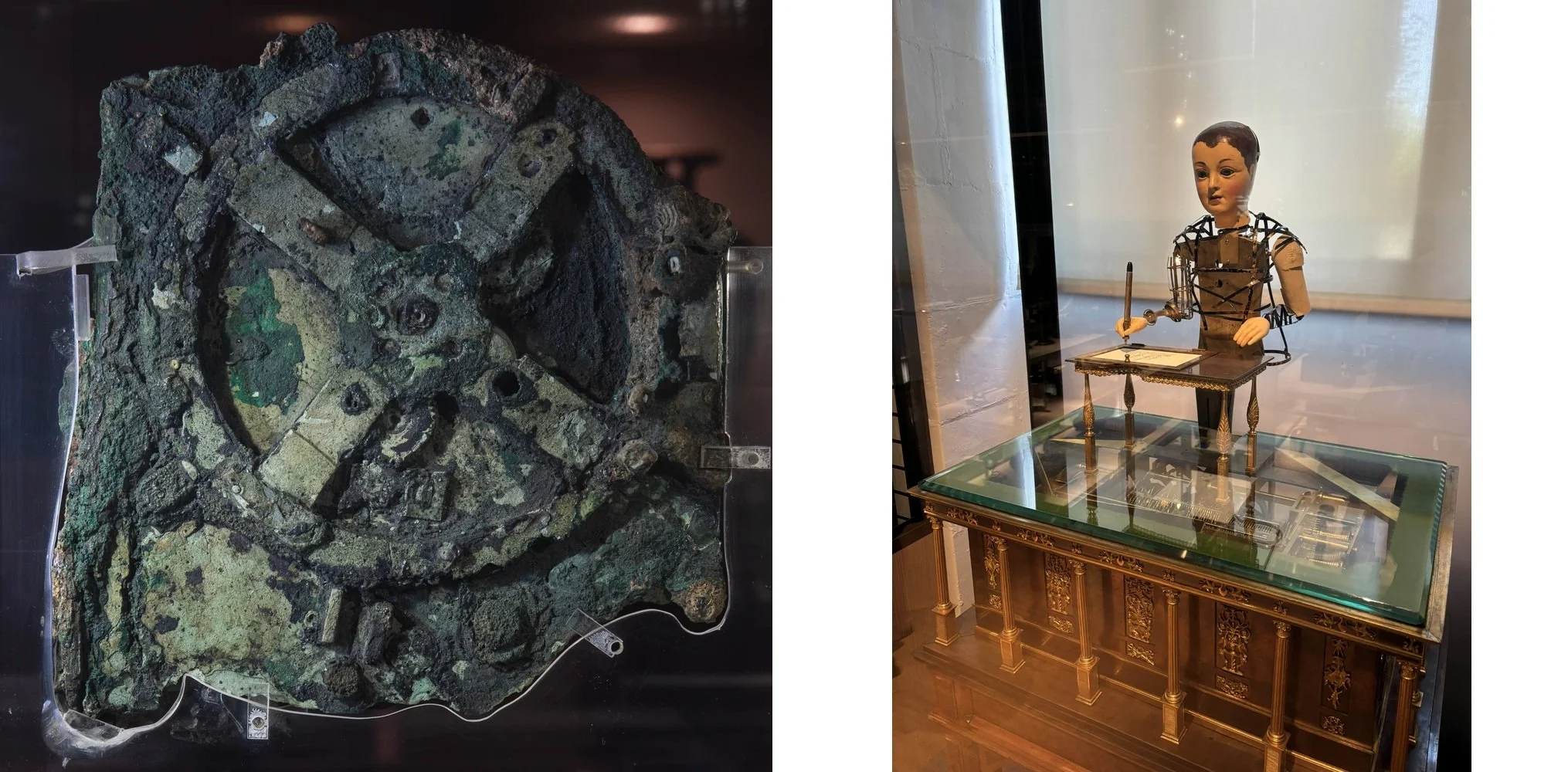
Left: The Antikythera mechanism, c. 200–80 BC. Its intricate bronze gearing is thought to have calculated astronomical positions and predicted eclipses. Right: Maillardet’s automaton, c. 1810. A clockwork figure programmed by cams cut into brass to draw pictures and write verse.
AI has immense capabilities and four core roles: to recognise, predict, generate, and optimise. Recognising involves using AI to identify a pattern or an object. For instance, using the app, Shazam, to work out what music is playing the background or medical devices that can automatically diagnose skin cancers. Predicting is where the AI tries to estimate what is likely to happen next. Many organisations such as the Earth Sciences New Zealand, use this technology to predict the weather forecast (Gordon & Cowling, 2026). Generation of content by AI is becoming increasingly common, the quality is now at a level where it is hard to decipher what is real or fake. So much so that Apple has put technology such as Reference Image into their latest iPhones, which creates an unalterable reference image to verify photo authenticity (Charlton, 2026). Lastly, optimisation is where AI is used to adjust a system toward a better result from data and feedback. For instance, how google maps will estimate the best travel routes to avoid traffic.
AI is not perfect and is prone to making mistakes. A common issue is that AI can 'hallucinate' or fabricate data. There are examples of lawyers using AI to help write the court filings; where it has presented fake legal cases, judges, and rulings (Feathers, 2026). Recent research in New Zealand, investigated 3000 journal papers and found that over 2% of them had fabricated references (Han et al., 2026).
So what does this have to do with your hearing?
Well, quite a lot.
Researchers have already put ChatGPT through the Taiwan audiologist licensing examination, where it scored 75 percent against a pass mark of 60 (Wang et al., 2024), and newer models sitting the following year's paper did better again (Qi et al., 2025). That is a good pub quiz fact and not much more, because an examination only measures whether you know the answers. It does not measure whether you can settle somebody who has put this appointment off for eight years, or make a judgement call when the test results and the person's story disagree with each other, or sit with a family while they take in news they were not expecting.
There is a deeper version of this point. A system that learns to read audiograms has been trained on many thousands of them, far more than I will see in my whole career. Every one of those lines is somebody's hearing, and the system has never performed a hearing test, never looked in an ear, and never met a single one of those people. It has no idea what it is like to mishear your own grandchildren, or to stop going to the golf club because the clubrooms are too noisy to follow anything. AI can have enormous experience without ever having any lived experience, and hearing loss is a condition where almost everything that matters happens in the lived part.
That is also why the hearing test itself resists automation more than it looks like it should. Deciding whether a response is real or a guess, working out that somebody is answering the question they think you asked rather than the one you did, noticing that the audiogram in front of you does not match the way the person is behaving in the room, all of it is judgement made in real time by somebody watching a human being rather than a screen.
Where AI genuinely earns its place is a narrower job, and it has been doing it quietly for years inside the device sitting on somebody's ear.
What the AI in a hearing aid is actually doing
Every manufacturer now uses the term, so it helps to know what sits underneath it. Almost all of it comes down to the fourth of those four roles, optimisation, running a few hundred times a second while you get on with your day.
Environmental classification. The aid decides what kind of room you are in, then changes its own settings to suit. A quiet lounge, a car, a cafe and a concert all get treated differently, and you are never asked.
Directionality. Which microphones to favour, and how tightly, as the room changes around you. The better systems now steer toward a voice rather than simply pointing forwards.
Noise reduction. Deciding what to attenuate and what to leave alone. This is the feature with the best laboratory results and the thinnest real-world evidence, which is worth holding in mind when you read the brochure.
Own voice handling. Recognising your voice as separate from everybody else's and processing it differently, because the thing most new wearers complain about first is the sound of themselves.
Personalisation. Presenting you with two versions of a setting, letting you choose between them, and learning from what you pick. Up to half of wearers end up preferring something other than the prescribed formula, which tells you how much of this is preference rather than physics.
What is real, and what is marketing
Oticon currently advertises the world's first dual AI hearing aid. Signia has put a small superscript AI after the name of nearly every feature in its MaX range. The other manufacturers are all running some version of the same line.
Some of this is genuinely new. Deep neural networks trained on millions of real sound scenes do behave differently from the rule-based processing of ten years ago, particularly in busy rooms, and fitting that much computing power into something the size of a coffee bean is a real engineering achievement.
A good deal of it is also the same signal processing that has been improving steadily for two decades, wearing a newer badge. Environmental classification has been in hearing aids since the early 2000s. Directional microphones are older than that. The word AI on a box tells you almost nothing about whether one device will suit you better than another, because two aids that both claim it can perform completely differently in the same restaurant on the same night.
There is also a limit that no amount of processing gets around. The aid is recognising patterns in sound, and a pattern is not an understanding. It does not know that the voice it has decided to suppress belongs to your grandson, or that the restaurant you have just walked into is the one where you gave up trying last year. It is making a very fast statistical guess about what you probably want to hear.
Two of the newest AI-powered hearing aids: the Signia Pure Charge&Go IX Max (left) and the Oticon Reveal (right).
Six reasons you still need a person
Somebody has to look in the ear. A good number of the people who come to see me convinced their hearing has deteriorated have wax, or an infection, or something that needs a doctor rather than a hearing aid.
Somebody has to fit it. Getting a device physically into an ear, comfortable enough to wear all day, with the right acoustics for that ear and that loss, and confirming it is doing what it is supposed to be doing.
Somebody has to interpret the result. A set of numbers is not a diagnosis. An asymmetry, a sudden change, or a pattern that does not fit the history all mean something, and what they mean sometimes has nothing to do with hearing aids.
Somebody has to help you choose. No algorithm weighs up nine manufacturers, your budget, your dexterity, your phone, your job and what funding you are entitled to, and then has to live with the answer alongside you.
Somebody has to sit with you. Most of the outcome in hearing care is made in the conversation rather than in the device. Expectations, patience through the first fortnight, and somebody willing to keep adjusting until it is right.
Somebody has to be responsible. If an algorithm gets a decision about your hearing wrong, it cannot be held to account for it. A clinician can.
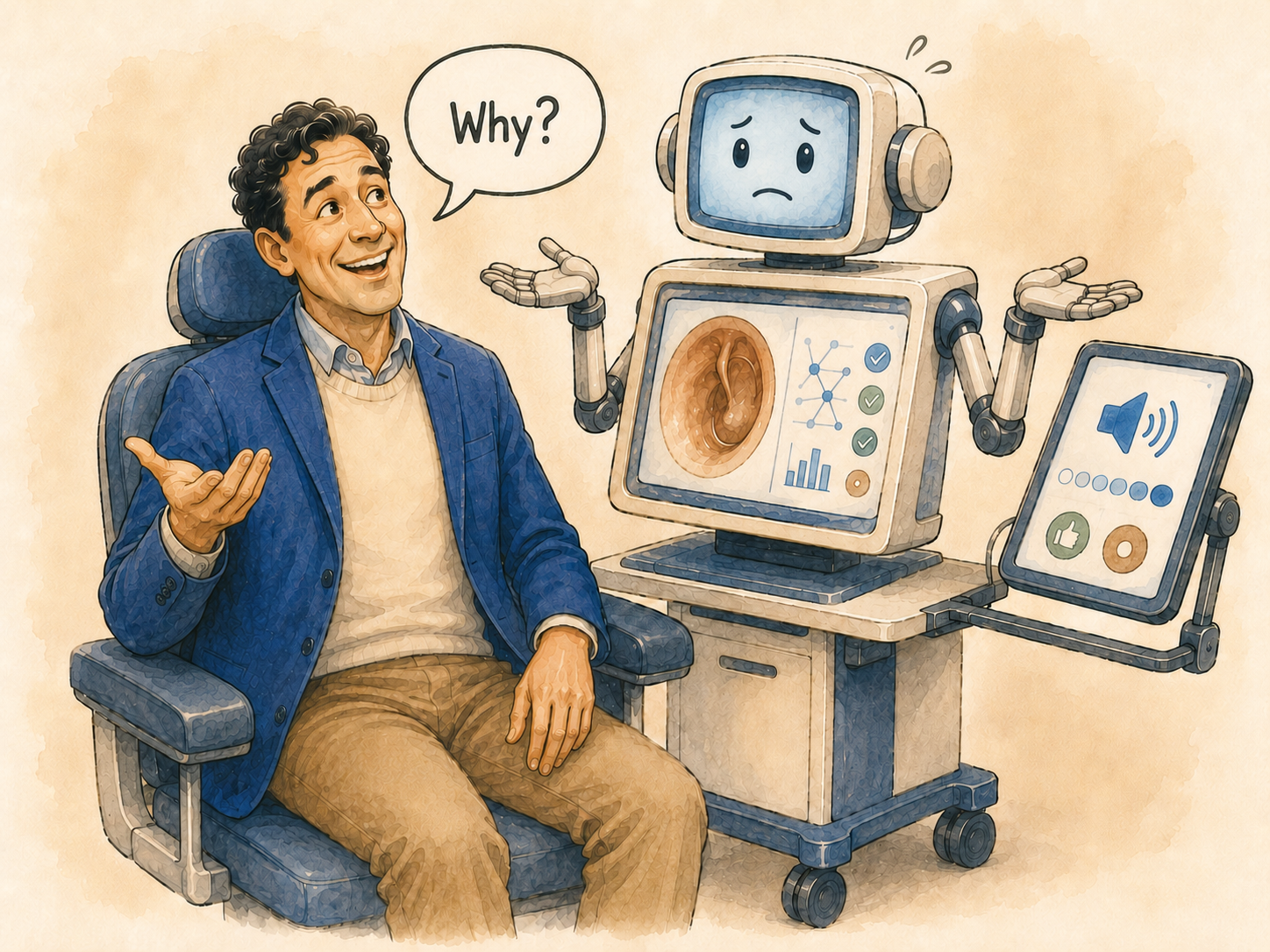
Where this is heading?
The gains that matter to patients are fairly ordinary ones. Aids that classify environments, separate speech from noise and learn preferences more effectively than the generation before them are a real improvement for anybody who spends their life in busy rooms. Tools that handle the documentation and the administration hand hours back, and those hours turn into time in the room with the person in front of me rather than time at a keyboard afterwards.
None of that looks like an AI system running the show while the clinician disappears. It looks like systems working quietly in the background, with an audiologist still responsible for the person, the decision and the relationship.
The best future for hearing care probably isn't AI instead of an audiologist. It's an audiologist who knows how to use AI well.
References
Charlton, H. (2026, September 9). IPhone 18 pro introduces "apple reference image" to verify photo authenticity. MacRumors. https://www.macrumors.com/2026/09/09/apple-reference-image/
Feathers, C. (2026). Beyond the Mirage: Beware of Generative AI and Hallucinations. in the Legal Profession, 37.
Gordon, N. and Cowling, R. (2026), Can Artificial Intelligence write the weather forecast?. Weather, 81: 136-138. https://doi.org/10.1002/wea.70069
Han, C., Manoharan, S., Ye, X., & Speidel, U. (2026). Phantom citations: An empirical study of non-existent and unverifiable references in scholarly literature. Journal of the Association for Information Science and Technology.
Qi, B., Zheng, Y., Wang, Y., & Xu, L. (2025). Comparison of ChatGPT and DeepSeek on a standardized audiologist qualification examination in Chinese: Observational study. JMIR Formative Research, 9, e79534. https://doi.org/10.2196/79534
Seiradakis, J. H., & Edmunds, M. G. (2018). Our current knowledge of the Antikythera Mechanism. Nature Astronomy, 2(1), 35-42. https://doi.org/10.1038/s41550-017-0347-2
Wang, S., Mo, C., Chen, Y., Dai, X., Wang, H., & Shen, X. (2024). Exploring the performance of ChatGPT-4 in the Taiwan audiologist qualification examination: Preliminary observational study highlighting the potential of AI chatbots in hearing care. JMIR Medical Education, 10, e55595. https://doi.org/10.2196/55595